Cash secured put tracker
To track a cash secured put, log the ticker, strike, expiry, contracts and premium. Then record how it ends: expired worthless, bought back, rolled or assigned. If assigned, also record the shares at the strike. The cash to set aside is the strike times 100 times the contracts.
What to record on a cash secured put
A cash secured put is a short put backed by enough cash to buy the shares if you are assigned. You sell one put for each 100 shares you would be willing to buy. The record needs one leg and a few numbers.
| Field | What to write |
|---|---|
| Ticker | The stock or ETF |
| Strike | The price you would pay per share if assigned |
| Expiration | The date the put ends |
| Contracts | One contract covers 100 shares |
| Premium | What you received, per share, from your broker confirmation |
| Cash set aside | Strike x 100 x contracts |
| Date opened | The day of the fill |
| Reason | One line on why you sold it |
The four endings
A cash secured put ends in one of four ways, and each is recorded differently.
| Ending | What happened | What to record |
|---|---|---|
| Expired worthless | The stock finished at or above the strike | Close the put at 0 on the expiration date. The premium is the result |
| Bought back | You paid to close it before expiration | Close the put at the price you paid. The result is the premium minus the buyback |
| Rolled | You bought it back and sold another put | Link the two puts as one chain, with the net credit or debit |
| Assigned | You bought 100 shares per contract at the strike | Close the put and open a stock position at the strike |
How much cash is tied up
The same premium ties up different amounts of cash on different stocks. A put with a $62 strike needs $6,200 per contract. A put with a $310 strike needs $31,000 per contract. Write the cash figure at entry so you can see what each put holds back.
XYZ trades at 66. You sell 2 contracts of the 62 put for 1.35, 38 days from expiration.
Premium: 1.35 x 100 x 2 = $270
Cash to set aside: 62 x 100 x 2 = $12,400
Break-even at expiration: 62 minus 1.35 = 60.65
Worst case, if the shares fall to zero: (62 minus 1.35) x 100 x 2 = $12,130
Your broker sets the actual requirement, so check their rules before you rely on this figure.
If the put is assigned
Close the put and open a stock position at the strike. Counting the premium as the put's own result keeps the option result and the stock result separate. How to record an options assignment has a worked example and the other way to count it.
Rolling a put
To roll, buy the put back and sell a new one, usually with a later expiration and sometimes a lower strike. Log both as one chain with the net credit or debit. The cash to set aside follows the new strike, so check it before you sell. How to track options rolls goes through the arithmetic.
Review by ticker
Group your closed puts by ticker and count how many expired, how many you bought back and how many were assigned. Add up the results for each stock as well.
Set one up in CFU Book
- Tap the plus button and type the ticker.
- Choose Cash Secured Put. It is one of the three choices under Quick add.
- Check the expiration and the strike.
- Enter the price you got, per share, and the number of contracts.
- Save the trade.
Expiration and alerts in CFU Book
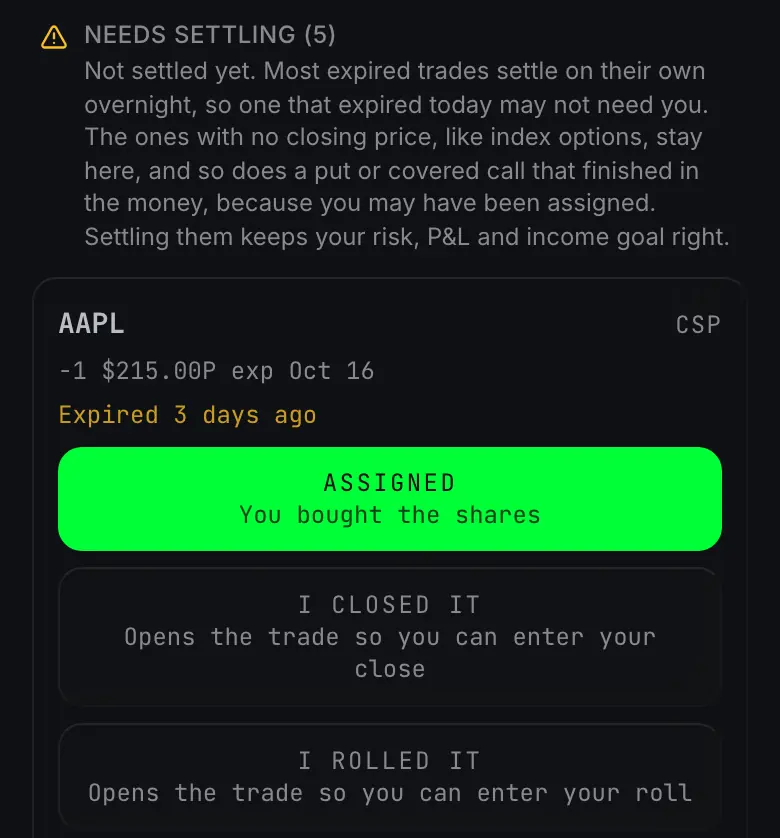
In CFU Book, a cash secured put or a covered call that expires in the money stays in Needs settling until you choose Assigned, I closed it or I rolled it. If you choose Assigned on a put, CFU Book records the shares at the strike and keeps your premium on the put. It shows strike minus premium as your cost after premium.
The FAQ lists the alerts CFU Book shows.
Questions and answers
How do you track cash secured puts?
Log each put with its ticker, strike, expiry, contracts and premium. Then record how it ends: expired worthless, bought back, rolled or assigned. If assigned, also record the shares at the strike. This keeps option results and stock results separate.
How much cash does a cash secured put need?
The full cost of the shares if assigned: strike price times 100 times the number of contracts. A $58 strike on one contract means $5,800 set aside. Your broker sets the actual requirement, so check their rules before you rely on this figure.
What happens to a cash secured put at expiration?
If the stock closes above the strike, the put expires worthless and you keep the premium. If it closes below, you may be assigned and buy 100 shares per contract at the strike.
How do you roll a cash secured put?
Buy the put back and sell a new one, usually with a later expiration. Record both fills and the net credit or debit as one chain, so the result of the trade covers every roll. The cash to set aside follows the new strike, so check it before you sell.
More from Cash Flow University
- Cash secured put scanner
A free tool to find a cash secured put for a US stock or ETF. - Options glossary
Options terms in plain English.
Log it in CFU Book. Free. No card. No trial.
Start free