What to track in an options trading journal
An options journal needs more than a stock log. Record the ticker, strategy, every leg with its strike and expiry, contracts, the fill for each leg, max loss at entry, the dates opened and closed, the exit and the result. Add one line on why you took the trade.
Why options need more than a stock log
A stock trade has one price in and one price out. An option contract covers 100 shares, so every price is multiplied by 100. A position can also have several legs, each with an expiration date, and it can be rolled, closed in part or assigned.
A log built for stocks has nowhere to put most of that. If it reads an option price of 0.85 as 85 cents, the entry is off by a factor of 100, because one contract at 0.85 is $85.
You buy 2 contracts of the XYZ 60 call at 3.40 and sell them at 4.15.
Gain per share: 4.15 minus 3.40 = 0.75
Result: 0.75 x 100 x 2 contracts = $150, before fees
The trade record
Copy these fields into whatever you keep your record in.
| Field | What to write | Why it matters |
|---|---|---|
| Ticker | The underlying, such as XYZ | Lets you review by stock |
| Strategy | Put credit spread, covered call, long call and so on | Strategies behave differently, so review them apart |
| Legs | For each leg: buy or sell, call or put, strike, expiration | The strikes set max profit, max loss and break-even |
| Contracts | One number per leg. Each contract is 100 shares | Every dollar figure scales with it |
| Entry fill | The price you got for each leg, per share, from your broker confirmation | A price on screen can differ from the fill |
| Net credit or debit | For the whole position, per share | The one number that starts the P&L |
| Max loss at entry | The most you can lose, in dollars | Written down before the trade moves |
| Dates | Opened and closed | Holding time and totals by month |
| Exit | The closing price and how it ended: closed early, rolled, expired or assigned | Each ending is recorded differently |
| Result | Dollars, before fees, summed across all legs | One result per trade |
| Reason | One line, written before you place the trade | Lets you check your thinking later, without hindsight |
Multi-leg trades: one entry, legs underneath
A spread, a condor or a poor man's covered call is one idea with several legs. Log it as one entry and keep the legs underneath it. Then max loss, break-even and P&L describe the whole trade. If each leg is its own entry, a protective leg looks like a separate bet, and the short leg looks riskier than it is.
PMCC stands for poor man's covered call: a far-dated long call and a near-dated short call.
The PMCC guide shows how to log one.
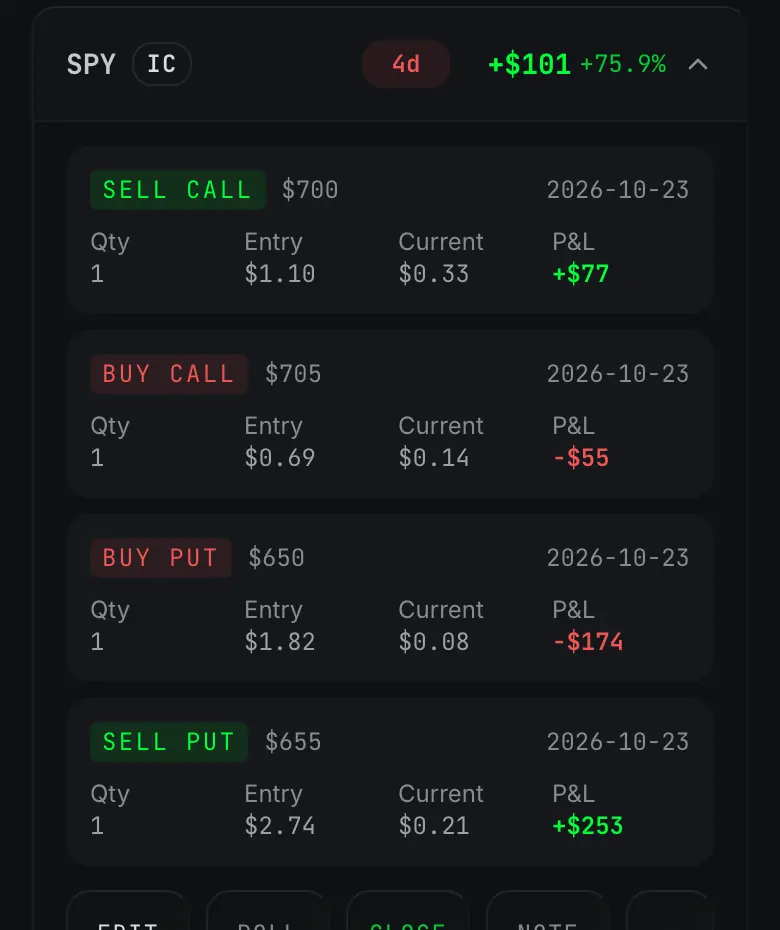
Write max loss at entry
Max loss is a number you can write before the trade moves, for any defined-risk structure.
| Structure | Max loss | Notes |
|---|---|---|
| Long call or long put | The price you paid | The option can expire worthless |
| Credit spread | Width minus net credit | Width is the gap between the strikes |
| Debit spread | The net debit you paid | Reached if both legs expire worthless |
| Iron condor | The wider wing minus the total credit | Only one side can lose at expiration |
| Cash secured put | Strike minus premium | If the shares fall to zero |
| Covered call | Your share cost minus the premium | If the shares fall to zero |
Multiply by 100 and by the number of contracts to get dollars. The put credit spread guide works one through.
What happens after entry
After entry, add a line to the same record for each thing that happens to the trade.
- A partial close: the contracts you closed and the price for them.
- A roll: the old position's close, the new position's open and the net credit or debit. See how to track options rolls.
- An assignment: the option ends and shares change hands. See how to record an options assignment.
- An expiration: a worthless option is a result dated at expiration.
Write the reason before you click
One line is enough, such as the level you are watching. Write it before you place the order. A month later it shows whether the trade did what you expected and whether your plan or the market changed.
Review by strategy and month
Once a month, group closed trades by strategy and by ticker. Compare the average win with the average loss. A high win rate with large losses can still lose money.
Paper, spreadsheet or app
| Format | Works well for | Gets hard when |
|---|---|---|
| Paper | A few trades and no setup | You roll, close in part or total a month by hand |
| Spreadsheet | Custom columns and your own formulas, often at no cost | Each leg and each roll needs its own row and formula |
| App | Legs and expirations kept together under one entry | You want a column the app does not have |
Keep the record in CFU Book
CFU Book is a free options trade journal from Cash Flow University. It keeps the legs of each trade together under one entry.
It does not connect to a brokerage, so you log each trade yourself. Results are before fees.
Questions and answers
What should an options trading journal include?
Ticker, strategy, every leg with strike and expiry, contracts, the fill price for each leg, max loss at entry, dates opened and closed, the exit price and the result. Add a one-line reason for the trade. For spreads, record the net credit or debit for the whole position.
How do you journal options trades?
Write the entry the same day, with every leg and fill, and update it when you close, roll or get assigned. Review once a month by strategy and by ticker. A short reason written before the trade lets you check your thinking later without hindsight.
Do you need to track the Greeks in a journal?
It is optional. Strikes, expiry, credit, max loss and results are enough to review a month. Greeks such as delta, which follows the stock's price, and theta, which follows time, help if you want to study why a trade behaved as it did.
Is a spreadsheet good enough for an options journal?
For a few trades a month, yes. It gets harder when you roll, close part of a position or hold legs on different dates, because each event needs its own row and formula. An app that stores legs does that arithmetic for you.
More from Cash Flow University
- Options glossary
Options terms in plain English.
Log it in CFU Book. Free. No card. No trial.
Start free