How to record an options assignment
When an option is assigned, record two things: the option ends, and shares change hands at the strike. Count the premium as a separate result on the option or as a lower cost per share, and keep one view. Your broker's share count and cash tell you which options were assigned.
What happens at assignment
When you sell an option, the buyer can use it. If they do, you are assigned. For a short put you buy 100 shares per contract at the strike. For a short call you sell 100 shares per contract at the strike.
A short option can be assigned on any trading day before it expires. A short option that finishes in the money is normally assigned at expiration. The notice from your broker can show up the next morning.
Record two events
An assignment ends one position and starts or ends another, so write both.
| What changes | Short put assigned | Short call assigned |
|---|---|---|
| The option | Closes | Closes |
| The premium | Counted as the option's result or in the share cost, as the next section explains | Counted as the option's result or in the share sale price, as the next section explains |
| The shares | You buy 100 per contract at the strike | You sell 100 per contract at the strike |
| Cash | Falls by strike x 100 x contracts | Rises by strike x 100 x contracts |
For a covered call the shares are ones you already own. Their result is the strike minus what you paid per share, times 100 for each contract.
Where the premium goes
There are two ways to count it. In the cash view the shares are recorded at the strike and the option keeps its premium as a separate result. In the cost view the premium lowers your cost per share: strike minus premium. Both give the same total once the shares are sold, so pick one and use it every time.
Your broker's tax figures can differ from your journal. A tax professional can say which applies to you.
An assigned put. You sell 1 contract of the XYZ 38 put for 1.62, and it is assigned.
Option result: 1.62 x 100 = $162, kept
Shares booked: 100 at 38.00 = $3,800 cash out
Cost after premium: 38.00 minus 1.62 = 36.38 per share, shown as information
You later sell the shares at 40.50. Stock result: (40.50 minus 38.00) x 100 = $250
Total for the idea: $162 plus $250 = $412
Check in the cost view: (40.50 minus 36.38) x 100 = $412
A covered call that is called away. You paid 45.20 per share, sold the 47 call for 1.05, and the shares are called away at 47.
Stock result: (47.00 minus 45.20) x 100 = $180
Call result: 1.05 x 100 = $105, kept
Total for the idea: $180 plus $105 = $285
Assignment on a spread
On a put credit spread the long put limits the loss if the short put is assigned. You then hold 100 shares per contract and still own the long put. You can sell both, or exercise the long put to sell the shares at its strike. Record the shares and the long put as their own events. The put credit spread guide covers the two-leg trade.
Check your broker
After each expiration, compare the share counts and the cash in your journal with your broker. If your journal says a put expired worthless and your broker shows 100 new shares, the put was assigned and the journal needs fixing.
Assignment in CFU Book
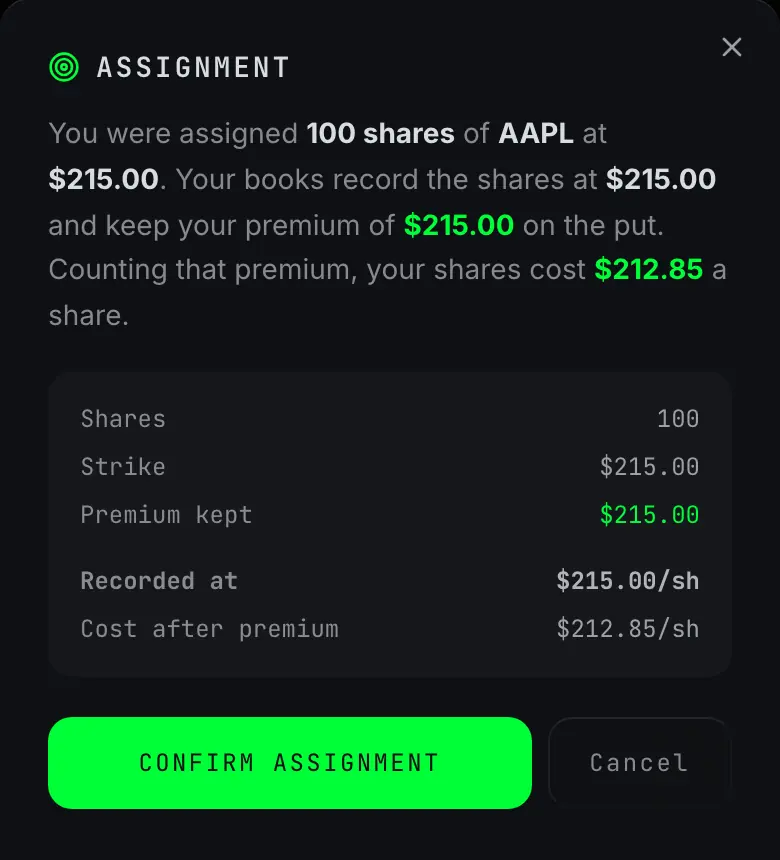
Needs settling appears on the Home screen. In CFU Book, a cash secured put or a covered call that expires in the money stays in Needs settling until you choose Assigned, I closed it or I rolled it. If you choose Assigned on a put, CFU Book records the shares at the strike and keeps your premium on the put. It shows strike minus premium as your cost after premium.
You can also tap Assign on an open cash secured put or covered call at any time, for example after an early assignment.
Questions and answers
How do you record an assigned put?
Close the put and open a stock position at the strike price. Then count the premium as the put's own result or as a lower cost per share, which is strike minus premium, and keep to the one you pick.
What is the cost basis after a put is assigned?
Your shares cost the strike in cash. Subtract the premium you collected to get the cost after premium: a $44 strike with a 1.80 premium gives $42.20. Your broker's tax basis can differ, and a tax professional can say which figure applies to you.
What happens when a covered call is assigned?
The shares are sold at the call's strike and the call ends. Your stock result is the strike minus what you paid per share. Count the premium you collected as the call's own result, or add it to the sale proceeds, and keep to one way. Record both events so the totals match your broker.
How do I know if I was assigned?
Your broker shows the stock position change and sends a notice, sometimes the next morning. Compare your share count with your journal. CFU Book does not connect to your broker, so you tell it what happened. A cash secured put or covered call that expired in the money waits in Needs settling for your choice, and you can tap Assign on one that is still open.
More from Cash Flow University
- Options glossary
Options terms in plain English.
Log it in CFU Book. Free. No card. No trial.
Start free