How to track an options roll
To track a rolled option, link the old and new positions into one chain. Record the close of the old option, the open of the new one and the net credit or debit. The result is the sum of every leg in the chain. CFU Book counts a rolled trade as one trade.
A roll in your records
A roll has two parts. You buy the old option to close it and sell a new option to open it, often in a single order. Your broker lists the two fills separately, so link them in your record as one decision.
The new option usually has a later expiration, and often a different strike. The roll is a net credit if the new option brings in more than the buyback costs, and a net debit if it brings in less.
Log one chain
If you record the two halves as unrelated trades, the loss on the first can hide behind the credit on the second.
You sell 1 contract of the XYZ 130 put at 3.10. The stock falls. You buy the put back at 5.40 and sell the next XYZ 130 put, with a later expiration, at 6.35. Later you buy that one back at 2.05.
| Leg | Action | Price | Cash |
|---|---|---|---|
| First put | Sell to open | 3.10 | +$310 |
| First put | Buy to close | 5.40 | -$540 |
| Next put | Sell to open | 6.35 | +$635 |
| Next put | Buy to close | 2.05 | -$205 |
| Chain total | +$200 |
Roll credit: 6.35 minus 5.40 = 0.95
Chain result: 3.10 minus 5.40 plus 6.35 minus 2.05 = 2.00 per share, $200 per contract
Taken apart, the first put lost $230 and the next one made $430. The chain made $200 in total, so the last leg alone overstates it by $230.
The credit or debit of a roll
The net credit or debit of a roll is the price you received for the new option minus the price you paid to close the old one. In the example that is 6.35 minus 5.40, a credit of 0.95. Record a net debit the same way, with its sign.
The total across the chain
The chain is finished when its last leg closes. Until then, the open legs are marked at the current quote. The P&L of the chain is the cash from every closed leg plus what the open legs are worth now.
Rolling one leg of a multi-leg position
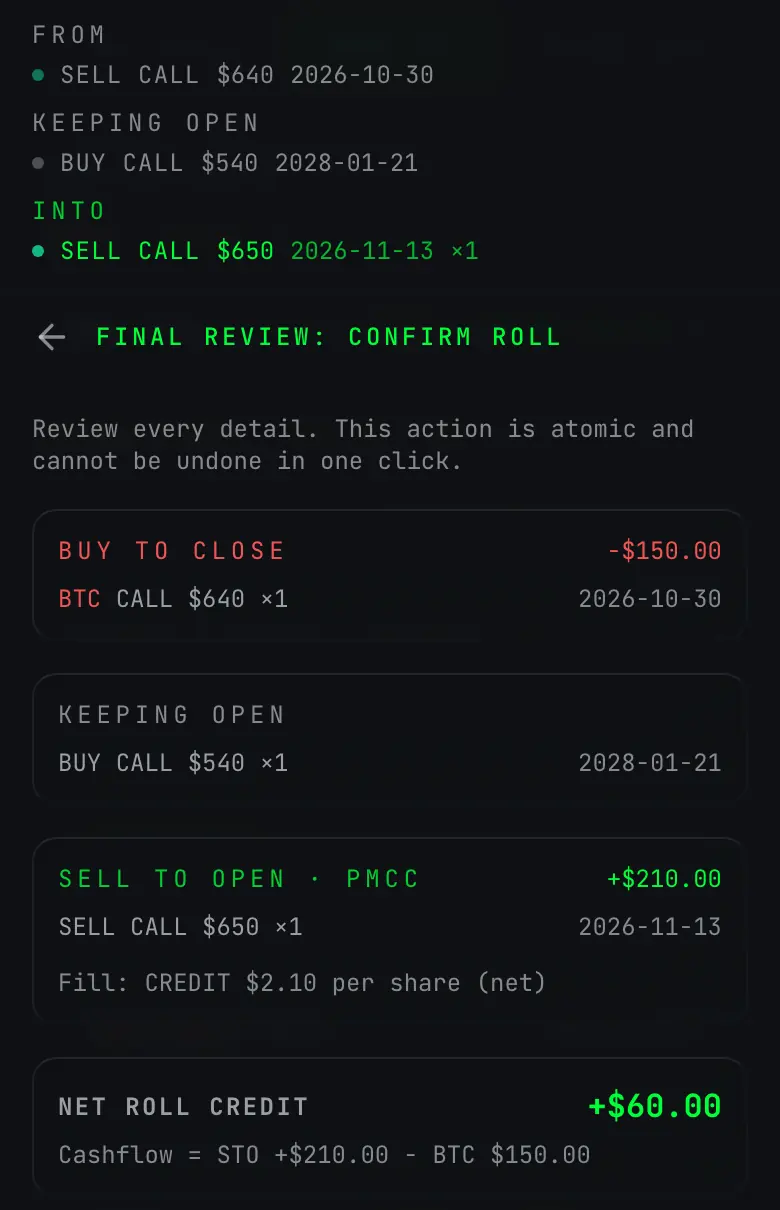
On a spread you can roll both legs or only one. On a poor man's covered call you usually roll the short call and keep the long call open. Record only the legs that changed, and leave the rest of the position as it was. The PMCC guide shows the two-leg case.
Mistakes to avoid
- Counting only the last leg, which leaves out the earlier legs.
- Leaving out the buyback, so the roll looks like a free credit.
- Resetting the entry price on every roll, which drops the cost of the chain.
- Mixing up signs, so a debit is entered as a credit.
This guide covers records only. How a roll is taxed depends on where you live, and that is a question for a tax professional.
Log a roll in CFU Book
A roll in CFU Book closes the old option, opens the new one and shows the net credit or debit. The new position joins the same roll chain, and the chain keeps one running total.
- Tap Roll on the position.
- If the position has more than one leg, pick the legs to roll.
- Enter the price you paid to close the old option.
- Choose the new expiration and strike.
- Enter the price you got for the new option.
- Review the net credit or debit, then confirm.
Questions and answers
How do you track rolled options?
Link the old and new positions as one chain. Record the close of the old option, the open of the new one and the net credit or debit of the roll. The trade's result is the sum of every leg in the chain, so the total stays visible after several rolls.
How do you calculate P&L after rolling an option?
Add the cash from every leg of the chain, counting options you sold as positive and options you bought, buybacks included, as negative. Multiply the per-share prices by the contracts and by 100. The sum is the chain's result once every leg is closed. Open legs are marked at the current quote until then.
Does a roll count as a closed trade?
No. A rolled trade counts as one trade. It is finished when every leg in its chain is closed, and its result is the sum of all its legs. Your broker may show each roll as a separate closed position, so expect the two views to differ.
What is a roll chain?
A roll chain is the series of positions linked by rolls: the original, the first roll, the second roll and so on. Keeping them linked gives one number that includes every buyback. The chain is finished when its last leg closes, and its result is the sum of every leg.
More from Cash Flow University
- Rolling credit spreads: when to roll and when to close
A Cash Flow University article on rolling put credit spreads.
Log it in CFU Book. Free. No card. No trial.
Start free