Poor man's covered call tracker
A poor man's covered call (PMCC) has two legs on two dates: a far-dated long call and a near-dated short call. Log both legs, then link each short call you sell or roll into one chain. Keep your own running net cost per share. In CFU Book you can roll the short call and leave the long call open.
Two legs, two expiries
A PMCC is a covered call built with a long-dated call in place of 100 shares. The long leg is a LEAPS call, an option with an expiration a year or more away. Against it you sell a call that expires sooner, and you can sell another each time that one ends. The two legs expire on different dates, so the record has to show each one.
What to record on the long call
| Field | What to write |
|---|---|
| Strike and expiration | The strike you bought and the far expiration date |
| Cost | What you paid, per share, from your broker confirmation |
| Contracts | One contract covers 100 shares |
| Date opened | The day of the fill |
The cost of the long call is where your net cost starts.
What to record on each short call
For every short call write the strike, the expiration, the credit per share and the date you sold it. When you roll one, also write what you paid to buy the old call back and what you received for the new one.
Keep a running net cost
Net cost per share is the cost of the long call, minus the credits from the short calls, plus the cost of any buybacks. It shows how much of the long call's price the short calls have recovered.
You buy a LEAPS call for 12.00. You sell the first short call for 1.50. Later you buy that call back for 0.80 and sell the next one for 1.40.
After the first short call: 12.00 minus 1.50 = 10.50 net cost
After the roll: 10.50 plus 0.80 minus 1.40 = 9.90 net cost
Per contract: 9.90 x 100 = $990
The trade's note is a place to keep that figure. CFU Book shows a different number, the chain's Campaign P&L, described below.
Roll the short call and keep the long call
When the short call nears expiration you can buy it back and sell the next one while the long call stays open. Record the buyback and the new credit. The long call keeps its own record until you close it or it expires. The options roll guide has a full worked example.
Close each leg at its own price
The legs have different expirations, so they have different prices. Closing a PMCC takes two prices, one for the long call and one for the short call. The result of the position is the sum of both legs, plus every earlier short call.
If the short call is assigned
A short call can be assigned. The long call gives you no shares, so assignment leaves you short 100 shares per contract until you cover them or exercise the long call. Record the short shares and the long call as their own events.
How to record an options assignment covers puts and covered calls.
How CFU Book handles a PMCC
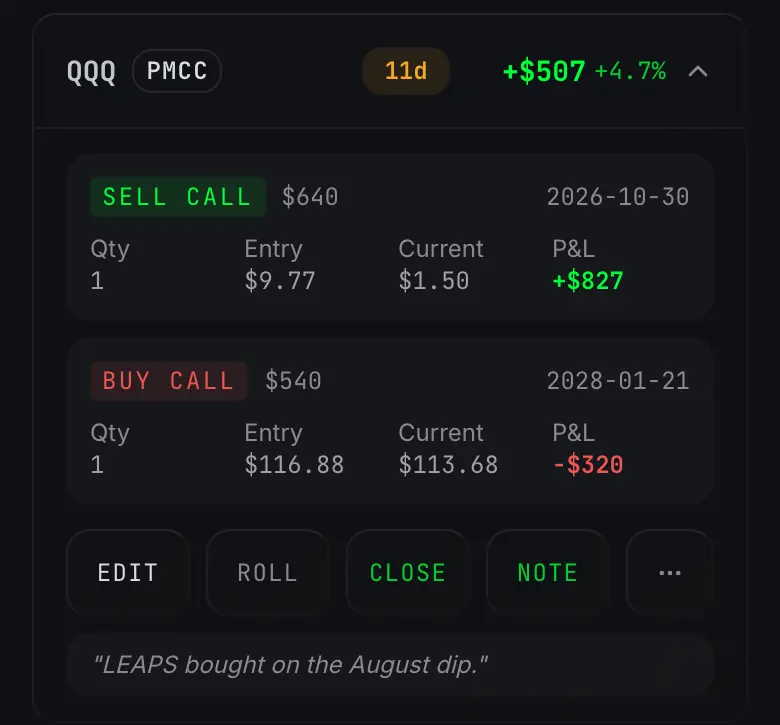
CFU Book keeps a PMCC and its rolls in one chain. It shows the chain's Campaign P&L, which is what the closed legs made plus what the open legs are worth now, and a Roll History with each link.
When you close a PMCC, each leg gets its own price, because the legs expire on different dates.
Expiration alerts watch every open leg, so the short call and the long call of a PMCC are each warned as their own dates approach.
Questions and answers
How do you track a poor man's covered call?
Treat it as one position with two legs: the long call you bought and the short call you sold against it. Log both with their own strikes and expiries. Each time you sell or roll a short call, link it into one chain with the long call and keep a running total of credits.
How do you calculate the net cost of a PMCC?
Start with the cost of the long call. Subtract the credit from each short call you sell and add the cost of each buyback. Keep the figure per share, then multiply by 100 for each contract. A LEAPS call bought for 12.00, a 1.50 credit, a 0.80 buyback and a 1.40 credit leave a net cost of 9.90, or $990 per contract.
Can you roll a PMCC without closing the LEAPS?
Yes. The short call is its own leg, so you can buy it back and sell a new one while the long call stays open. The new short call joins the same roll chain.
What is a LEAPS call in a PMCC?
A LEAPS call is a call option with an expiration a year or more away. In a poor man's covered call it takes the place of 100 shares, and you sell shorter-dated calls against it. Log it with its own strike, expiry and cost, because it expires on a different date from each short call.
More from Cash Flow University
- Wheel vs LEAPS vs poor man's covered call
A Cash Flow University comparison of capital needed, max loss and time horizon. - Why a broker may not let you sell a call against your LEAPS
A Cash Flow University article on spread approval.
Log it in CFU Book. Free. No card. No trial.
Start free