Put credit spread tracker
To track a put credit spread, log it as one trade with two legs: the short put and the long put, with the same expiry and contract count. Record the net credit for the pair, then how it ends: closed early, rolled or expired. One entry per spread keeps max loss and P&L right.
What to record on a put credit spread
A put credit spread has two legs on the same stock. You sell a put at a higher strike and buy a put at a lower strike. Both legs share one expiration and one contract count. The lower put is protection, because it caps what the spread can lose.
Log the pair as one trade. If you log the two puts as separate trades, the short put looks like an uncovered put and neither record shows the risk of the spread.
| Field | What to write |
|---|---|
| Ticker | The stock or ETF |
| Expiration | One date for both legs |
| Short put | The higher strike you sold |
| Long put | The lower strike you bought |
| Contracts | One number for both legs. Each contract covers 100 shares |
| Net credit | What you received for the pair, per share, from your broker confirmation |
| Date opened | The day of the fill |
| Reason | One line on why you took the trade |
The numbers to write down at entry
Five numbers describe the trade before it moves. Write them down the day you open it.
| Number | How to get it |
|---|---|
| Net credit | Credit from the short put minus the cost of the long put |
| Width | Short strike minus long strike |
| Max profit | Net credit x 100 x contracts. You keep it if both puts expire worthless |
| Max loss | (Width minus net credit) x 100 x contracts. You lose it if the stock finishes at or below the long strike |
| Break-even | Short strike minus net credit. At this price at expiration the trade finishes even |
XYZ trades at 98. You sell one 95 put for 2.10 and buy one 90 put for 0.90, same expiration.
Net credit: 2.10 minus 0.90 = 1.20 per share
Width: 95 minus 90 = 5.00
Max profit: 1.20 x 100 = $120
Max loss: (5.00 minus 1.20) x 100 = $380
Break-even: 95 minus 1.20 = 93.80
How a put credit spread ends
You can close a spread early, roll it or let it expire. If it expires, the result depends on where the stock finishes. The table uses the same made-up numbers as above, for one contract.
| Stock finishes at | What happens | Result |
|---|---|---|
| 95 or higher | Both puts expire worthless | +$120 |
| 94.50 | The 95 put is worth 0.50 and the 90 put expires worthless | +$70 |
| 93.80 | Break-even | $0 |
| 92.00 | The 95 put is worth 3.00 | -$180 |
| 90 or lower | The spread is worth its full 5.00 width | -$380 |
A short put can be assigned before expiration, with the long put still in place. If that happens, the record needs a stock leg too.
How to record an options assignment covers the stock side.
Open P&L and closed P&L
Open P&L is the credit you took in minus what it would cost to buy the spread back at the current quote. Closed P&L is your credit minus the price you paid to close.
The spread now quotes 0.65. Open P&L: (1.20 minus 0.65) x 100 = $55 on paper
You close at a debit of 0.40. Closed P&L: (1.20 minus 0.40) x 100 = $80
Log the closing price from your broker confirmation. The quote you saw before you placed the order can differ from the price you got.
What a roll does to the record
A roll closes the spread you hold and opens a new one, usually with a later expiration. In your record it is one chain. The first spread's loss or gain stays on the books next to the second spread.
XYZ has fallen to 94 with six days left. The 95/90 spread quotes 1.90. You buy it back for 1.90 and sell a 92/87 spread for 2.30 with a later expiration.
Net credit of the roll: 2.30 minus 1.90 = 0.40
Chain credit so far: 1.20 minus 1.90 plus 2.30 = 1.60
First spread alone: (1.20 minus 1.90) x 100 = a loss of $70
Best case for the chain: the new spread expires worthless, +$160
Worst case for the chain: 1.60 minus 5.00 = a loss of $340
Read the chain total, because the new spread alone leaves out the loss on the first one.
The options roll guide goes through a roll leg by leg.
Call credit spreads work the same way
A call credit spread is the mirror image. You sell a call at a lower strike and buy a call at a higher strike. Max loss is still the width minus the net credit. Break-even is the short call strike plus the net credit.
Mistakes that break the record
- Logging each leg as its own trade, which hides the capped risk.
- Writing the short put's price as the credit instead of the net for the pair.
- Forgetting the 100-share multiplier, so a credit of 1.20 reads as $1.20 instead of $120.
- Skipping the update after a roll, which drops the buyback.
Log a put credit spread in CFU Book
You log each trade yourself. CFU Book can suggest an expiration, strikes and a price from market data, and you change them to match your fill.
- Tap the plus button and type the ticker.
- Choose Put Credit Spread. It is the first choice under Quick add.
- Check the expiration, the put you sell and the put you buy.
- Enter the price you got for the spread, per share, and the number of contracts.
- Read the Most you can lose line, then save the trade.
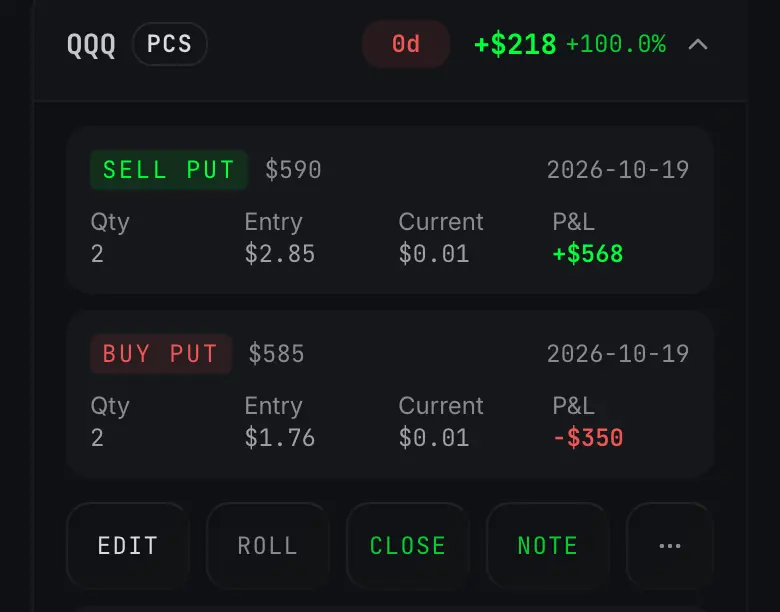
CFU Book shows the most you could lose on your open positions. When you log a spread, it shows the most you can lose before you save.
To roll the spread, tap Roll on the position. A roll in CFU Book closes the old option, opens the new one and shows the net credit or debit. The new position joins the same roll chain, and the chain keeps one running total.
Expiration alerts in CFU Book
CFU Book shows an alert when an option is 7 days from expiring and a stronger one when it is 2 days or less away. The FAQ lists the other alerts.
Questions and answers
How do you track a put credit spread?
Record it as one position with two legs: the short put and the long put, same expiry, same number of contracts. Log the net credit for the pair. Then record how it ends: closed early, rolled or expired. Tracking the pair as one trade keeps max loss and P&L correct.
How do you calculate max loss on a put credit spread?
Subtract the net credit from the width between the strikes, then multiply by 100 for each contract. A 5-wide spread that took in a 1.20 credit has a max loss of (5.00 minus 1.20) x 100 = $380 per contract. Write that figure down at entry, before the trade moves.
What is the break-even on a put credit spread?
The short put strike minus the net credit. With a 95 short put and a 1.20 credit, break-even at expiration is 93.80. At or above 95 you keep the full credit. Between 93.80 and 95 the trade still makes money. Below 93.80 it loses money, up to the max loss.
Is there a free put credit spread tracker?
CFU Book is free. There is no card, no trial and no paid tier. CFU Book supports put credit spreads, call credit spreads, put debit spreads, call debit spreads and iron condors. It does not connect to a brokerage, so you log each spread yourself.
More from Cash Flow University
- Cash Flow University's guide to credit spreads
Strikes, sizing, rolling and worked examples. - Put credit spread strategy: setup, strikes and exits
A Cash Flow University article on how it picks and manages them.
Log it in CFU Book. Free. No card. No trial.
Start free